
Shopping street · Frankfurt
Zeil
The Zeil is Frankfurt's main pedestrian shopping street and one of the highest-grossing retail streets in Europe. Department stores, the MyZeil mall and a farmers market at the Konstablerwache line a tree-shaded promenade.
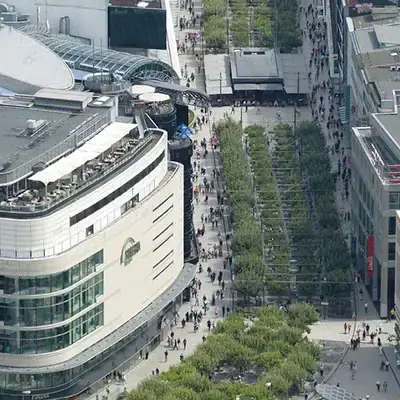
The Zeil is where Frankfurt shops. It runs east to west through downtown between two squares, the Hauptwache and the Konstablerwache, both of them major subway and commuter rail interchanges, and it consistently ranks as the busiest shopping street in Germany and one of the highest-grossing in Europe. Department stores and chains sit alongside specialty shops, and the whole thing is a pedestrian zone planted with plane trees, so it functions as a promenade as much as a mall.
For travelers the most useful stop is not a store. On Thursdays and Saturdays a farmers market takes over the Konstablerwache at the eastern end, where producers sell their own vegetables, cheese and wine. This is the easiest place in the city to try Grüne Soße, Frankfurt's green sauce, a cold sauce of hard-boiled eggs and seven herbs usually served over potatoes. It is the local dish, and Frankfurters are serious about it.
A practical tip that repeat visitors use: the B-Ebene, the underground concourse level at the Hauptwache, has banks of lockers, so you can drop your shopping bags and keep walking rather than carrying them around all afternoon. The rooftop terrace on the Kaufhof building is another local trick, with a free view over the skyline toward the Taunus hills.
The street has been remade repeatedly. A monumental main post office dominated the western section until it was destroyed in World War II. Department stores multiplied between 1900 and World War I. Bombing flattened much of the street along with the Hauptwache and the Katharinenkirche. Rail traffic gave way to wide roads in 1971, and in the early 1980s the entire Zeil was paved and planted, with an irrigation system that turned the young plane trees into the avenue you walk under today.
At the western end the Zeil runs into the Hauptwache and then continues as the Freßgass, literally the feeding alley, Frankfurt's culinary main street. It was named for the food shops, bakeries and butchers that once lined it. Today it has shifted upmarket toward luxury retail as an extension of the Goethestraße, with flagship stores and high-end restaurants, and the real estate along it is the most expensive in Frankfurt.
The Konstablerwache at the eastern end has its own history. An armory stood on the corner from 1544, converted to a police station in 1822, and the name comes from an old Frankfurt artillery rank. After the war, buildings destroyed by bombing were deliberately left unrebuilt to create the larger square that exists now, and the ground level was raised roughly 80 centimeters to make room for the subway and commuter rail station below.
More Frankfurt attractions
Landmark
Römer
Frankfurt's city hall since 1405 and the postcard image of the city. Three stepped gables facing the Römerberg square.
Church
Kaiserdom St. Bartholomäus
The Imperial Cathedral, where Holy Roman Emperors were crowned from 1562 to 1792. Its red sandstone tower defines the Old Town skyline.
Observation deck
Main Tower
The one Frankfurt skyscraper with a public observation deck. 656 feet of blue glass in the middle of the banking district.
Landmark
Paulskirche
The birthplace of German democracy. The first freely elected national assembly met in this oval church in 1848.
Museum
Goethe-Haus
The house where Johann Wolfgang von Goethe was born in 1749, rebuilt after the war and furnished with the family's original possessions.
Park
Palmengarten
One of Europe's largest botanical gardens: 54 acres of greenhouses, ponds and themed gardens in the Westend.
Image credits: authors, licenses and sources of all photos are listed on the image credits page.