
Park · Frankfurt
Palmengarten
The Palmengarten covers more than 22 hectares, roughly 54 acres, in the Westend-Süd neighborhood and holds over 13,000 tropical and subtropical species. The Palmenhaus of 1869 is one of the largest glass houses in the world.
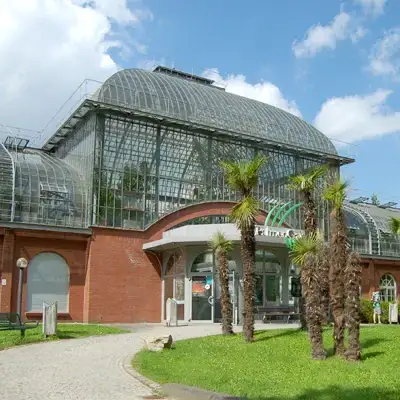
Frankfurt is a working city of banks and trade fairs, and the Palmengarten is where it goes to breathe. More than 22 hectares, about 54 acres, of lawns, ponds, themed beds and glass houses sit ten minutes by subway from the banking district, in the leafy Westend-Süd neighborhood. It ranks among the largest botanical gardens in Europe and is one of the most visited attractions in the city.
It exists because of a bargain. In 1868 the landscape architect Heinrich Siesmayer bought a large collection of exotic plants that Duke Adolph of Nassau had assembled, and Frankfurt citizens put up the money to build a garden around it. The garden opened to the public in 1871 and became famous fast. Buffalo Bill brought his Wild West show here in 1890 for its first German performance, which tells you something about how the Palmengarten was marketed from the start.
The collection today runs to more than 13,000 subtropical and tropical species, arranged by vegetation type across outdoor gardens and climate-controlled houses. Palms and subtropical plants live in the Palmenhaus, an elegant glass structure built in 1869 and rebuilt in 1929 after damage, still one of the largest greenhouses anywhere. The modern Tropicarium, at over 5,000 square meters or roughly 54,000 square feet, walks you through eight tropical biotopes including desert, rainforest, monsoon forest and mangroves. The Blütenhaus holds the flowering displays.
The garden has had an eventful institutional life. Greenhouses and beds were turned over to vegetable production to supply military hospitals during World War I. The city took ownership in 1931, American occupation forces ran it after World War II, and when it returned to city hands in the 1960s a long reconstruction began that was not finished until 1992.
Directly next door is the Botanical Garden of Goethe University, a separate institution now under joint administration. Between them the two gardens hold around 18,000 plant species, which makes this corner of the Westend one of the densest concentrations of living plant collections in Germany.
The Palmengarten is also a venue. Concerts and performances run through the season, the Grüne Schule education program has won repeated recognition for its work with schools and preschools, and the garden takes part in international seed exchange and conservation programs for endangered species. If your trip includes children, plan on half a day rather than an hour.
More Frankfurt attractions
Landmark
Römer
Frankfurt's city hall since 1405 and the postcard image of the city. Three stepped gables facing the Römerberg square.
Church
Kaiserdom St. Bartholomäus
The Imperial Cathedral, where Holy Roman Emperors were crowned from 1562 to 1792. Its red sandstone tower defines the Old Town skyline.
Observation deck
Main Tower
The one Frankfurt skyscraper with a public observation deck. 656 feet of blue glass in the middle of the banking district.
Landmark
Paulskirche
The birthplace of German democracy. The first freely elected national assembly met in this oval church in 1848.
Museum
Goethe-Haus
The house where Johann Wolfgang von Goethe was born in 1749, rebuilt after the war and furnished with the family's original possessions.
Museum district
Museumsufer
The Museum Embankment: a mile of major museums lined up along both banks of the Main, anchored by the Städel.
Image credits: authors, licenses and sources of all photos are listed on the image credits page.