
Museum district · Frankfurt
Museumsufer
The Museumsufer (Museum Embankment) is the row of museums along the Main river, concentrated on the Sachsenhausen side at the Schaumainkai. It is one of the densest museum districts in Europe, and the Städel is its most important address.
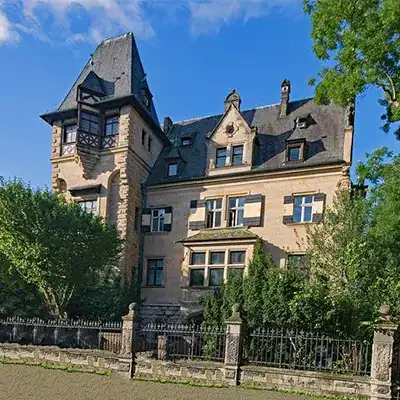
Most cities put their museums in a park. Frankfurt put them along a river, in a row of 19th-century villas and modern buildings on the south bank of the Main, and the walk from one to the next is half the pleasure. The stretch is called the Museumsufer, the museum embankment, and you can cross to it from the Old Town on the Eiserner Steg footbridge in about three minutes.
The Städel is the anchor and the reason art travelers come to Frankfurt at all. Officially the Städelsches Kunstinstitut, it holds 2,700 paintings, of which about 600 are on display, plus 100,000 drawings and prints and 600 sculptures across roughly 4,000 square meters of gallery space. German art critics named it museum of the year in 2012, the same year it recorded its highest ever attendance at 447,395 visitors.
Next along the bank, the Liebieghaus fills a late 19th-century villa with sculpture from ancient Greece, Rome and Egypt through the medieval, Renaissance, Baroque and neoclassical periods, with work from East Asia as well. A 2009 renovation added an open depot, so you can see parts of the collection that are not on permanent display. The garden around it holds sculptures too.
The Museum für Kommunikation is the oldest museum on the embankment, opened in 1958 as the federal postal museum and housed since 1990 in a transparent glass building by Günter Behnisch. Its main exhibition traces how humans have sent messages to each other, from mail and telegraphy through telephone, radio, television and computing. There is a dedicated children's exhibition floor, which makes it a good rainy-day option with kids.
Also on the south bank: the Museum der Weltkulturen (world cultures), the Deutsches Architekturmuseum with its permanent show on German architecture from early huts to skyscrapers, the Deutsches Filmmuseum on the history of moviemaking, the Ikonenmuseum with one of Germany's largest icon collections, the Museum Giersch, and the small contemporary exhibition space Portikus.
The north bank has fewer museums but two good ones: the Jüdisches Museum, whose permanent exhibition covers centuries of Jewish life in Frankfurt, and the Historisches Museum, which runs from Roman-era artifacts through the city's present.
One date to plan around: the Nacht der Museen, an annual night when the museums stay open late on a single combined ticket. If your trip lines up with it, buy in advance. Otherwise, budget a full day here. Trying to do the Museumsufer in two hours is the most common mistake visitors make.
More Frankfurt attractions
Landmark
Römer
Frankfurt's city hall since 1405 and the postcard image of the city. Three stepped gables facing the Römerberg square.
Church
Kaiserdom St. Bartholomäus
The Imperial Cathedral, where Holy Roman Emperors were crowned from 1562 to 1792. Its red sandstone tower defines the Old Town skyline.
Observation deck
Main Tower
The one Frankfurt skyscraper with a public observation deck. 656 feet of blue glass in the middle of the banking district.
Landmark
Paulskirche
The birthplace of German democracy. The first freely elected national assembly met in this oval church in 1848.
Museum
Goethe-Haus
The house where Johann Wolfgang von Goethe was born in 1749, rebuilt after the war and furnished with the family's original possessions.
Park
Palmengarten
One of Europe's largest botanical gardens: 54 acres of greenhouses, ponds and themed gardens in the Westend.
Image credits: authors, licenses and sources of all photos are listed on the image credits page.