
Church · Frankfurt
Kaiserdom St. Bartholomäus
Kaiserdom St. Bartholomäus (the Imperial Cathedral) is a Gothic hall church and the largest religious building in Frankfurt. Emperors were elected here from 1356 and crowned here from 1562 to 1792. The west tower and the banking towers behind it make up Frankfurt's signature silhouette.
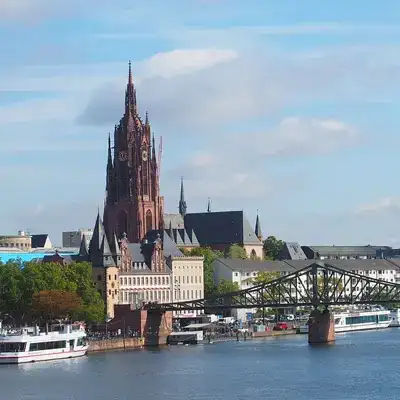
Americans often expect a cathedral to be a bishop's seat. This one never was. Frankfurt's Kaiserdom is called an imperial cathedral because of what happened inside it, not because of church hierarchy: from 1356 the electors chose the kings of Germany here, and from 1562 to 1792 the Holy Roman Emperors were crowned in front of the high altar. For a country that did not exist as a nation state until 1871, that made this red sandstone church a symbol of unity long before there was a Germany to unify.
The elections took place in the Wahlkapelle, a small chapel on the south side of the high choir built in 1425. It is a strikingly modest room for a decision that shaped central Europe for centuries. The building you walk into today is the third church on this spot. Excavations since the late 19th century have turned up foundations reaching back to the 7th century, when a Merovingian-era church stood beside the royal palace.
The landmark feature is the west tower, roughly 95 meters tall, which works out to a little over 310 feet. There is no elevator, so the view over the Old Town roofs and across to the banking district costs you 324 steps. It is one of the best value viewpoints in the city, and the contrast between medieval rooftops in the foreground and glass towers behind is the reason Frankfurt gets called Mainhattan.
Inside, three things are worth slowing down for: the 14th-century choir stalls, the Marian altar of 1434, and the Bartholomew frieze from the 15th century. The masterpiece is Hans Backoffen's crucifixion group of 1509, an early Renaissance work of real power. Goethe, who grew up a ten-minute walk away, wrote admiringly about the church in his autobiography.
Fire gutted the church in 1867 and it was rebuilt in the form you see now. Then came the war. Between October 1943 and March 1944 the largest surviving Gothic old town in central Europe was destroyed in six Allied raids, the worst on March 22, 1944. The cathedral's interior burned out completely, and the building was reconstructed through the 1950s.
The cloister houses the Dommuseum, with the cathedral treasury, sacred art from the 14th to the 20th century and Baroque liturgical vestments, plus rotating exhibitions in the Quadrum courtyard. The Frankfurter Domkonzerte concert series brings international performers here through the year and counts among the city's cultural fixtures.
Live from Booking.com
Hotels near Kaiserdom St. Bartholomäus
Current prices and availability for properties within about a mile of here.

Premier Inn Frankfurt City Centre
66 € / night

Hotel Victoria
66 € / night

TOWNHOUSE Hotel
67 € / night

City Hotel Frankfurt Central
71 € / night
* Sponsored - booking is handled by Booking.com. As of: September 24, 2026. Prices and availability change daily.
More Frankfurt attractions
Landmark
Römer
Frankfurt's city hall since 1405 and the postcard image of the city. Three stepped gables facing the Römerberg square.
Observation deck
Main Tower
The one Frankfurt skyscraper with a public observation deck. 656 feet of blue glass in the middle of the banking district.
Landmark
Paulskirche
The birthplace of German democracy. The first freely elected national assembly met in this oval church in 1848.
Museum
Goethe-Haus
The house where Johann Wolfgang von Goethe was born in 1749, rebuilt after the war and furnished with the family's original possessions.
Park
Palmengarten
One of Europe's largest botanical gardens: 54 acres of greenhouses, ponds and themed gardens in the Westend.
Museum district
Museumsufer
The Museum Embankment: a mile of major museums lined up along both banks of the Main, anchored by the Städel.
Image credits: authors, licenses and sources of all photos are listed on the image credits page.