
Museum · Frankfurt
Goethe-Haus
The Goethe-Haus is the birthplace and childhood home of Johann Wolfgang von Goethe, Germany's most celebrated writer. He wrote Götz von Berlichingen and The Sorrows of Young Werther at the desk on the top floor. The house was destroyed in 1944 and reconstructed by 1951.
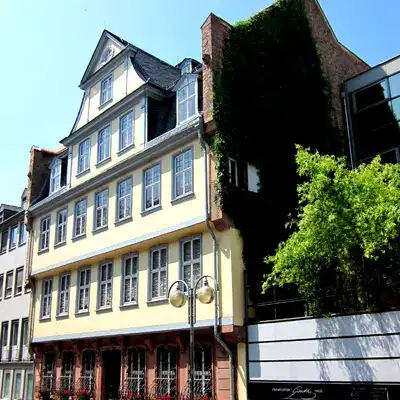
Goethe is to German literature roughly what Shakespeare is to English, and this is the house where he was born on August 28, 1749, to a lawyer father and a mother who was the daughter of Frankfurt's mayor. He lived here with his sister Cornelia until he left for Leipzig to study law at 16, and he came back to write the two works that made him famous across Europe before he turned 25: the play Götz von Berlichingen in 1773 and the novel The Sorrows of Young Werther in 1774. The desk where he wrote them is still upstairs, and he laid the groundwork for Faust in the same rooms.
The building started as two houses from around 1600 in the local half-timbered style. Goethe's grandmother bought the property in 1733, and his father spent until 1755 rebuilding and modernizing it. In his autobiography Goethe notes that his father was careful to keep the double overhang of the facade, which new construction was no longer allowed under the building codes of 1719 and 1749, by insisting the work was a remodel rather than a new build.
The family sold up in 1795 and the house passed through a series of owners until the geologist Otto Volger bought it in 1863 and restored it to the state the Goethes had left it in. That restoration is why the museum feels like a home rather than a display case.
On March 22, 1944, exactly 112 years after Goethe's death, an Allied raid leveled the whole street and left the house almost completely destroyed. Reconstruction began in 1947 under the architect Theo Kellner and provoked a genuinely fierce public argument in Frankfurt: some saw a faithful rebuild as a duty, others as a fake. The supporters, among them Nobel laureate Hermann Hesse and the philosopher Karl Jaspers, won. The house reopened in 1951.
Here is the detail that makes a visit worthwhile rather than merely dutiful. Most of the contents had been moved out of the city during the war: furniture, books, paintings, objects and Goethe manuscripts owned by the family. They came back when the reconstructed house opened, so what you see in the rooms is largely the real thing inside a rebuilt shell.
The tour takes you through the kitchen with its coal range and hand water pump, the reading room with its wall of books, the tea and dining rooms, and finally the poet's own room. Rotating thematic exhibitions run alongside the permanent display, and the house now sits within the Goethehöfe complex next to the German Romanticism Museum.
More Frankfurt attractions
Landmark
Römer
Frankfurt's city hall since 1405 and the postcard image of the city. Three stepped gables facing the Römerberg square.
Church
Kaiserdom St. Bartholomäus
The Imperial Cathedral, where Holy Roman Emperors were crowned from 1562 to 1792. Its red sandstone tower defines the Old Town skyline.
Observation deck
Main Tower
The one Frankfurt skyscraper with a public observation deck. 656 feet of blue glass in the middle of the banking district.
Landmark
Paulskirche
The birthplace of German democracy. The first freely elected national assembly met in this oval church in 1848.
Park
Palmengarten
One of Europe's largest botanical gardens: 54 acres of greenhouses, ponds and themed gardens in the Westend.
Museum district
Museumsufer
The Museum Embankment: a mile of major museums lined up along both banks of the Main, anchored by the Städel.
Image credits: authors, licenses and sources of all photos are listed on the image credits page.