
Landmark · Frankfurt
Paulskirche
The Paulskirche (St. Paul's Church) hosted the Frankfurt Parliament of 1848, the first freely elected legislature for all of Germany. It is no longer used as a church but as a ceremonial hall, best known for the annual Peace Prize of the German Book Trade.
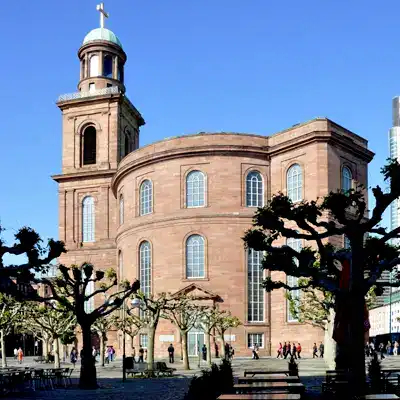
For Americans, the closest reference point is Independence Hall in Philadelphia: a plain building where people sat down and tried to write a constitution. In May 1848 the delegates of the first freely elected German national assembly met in this oval sandstone church, and for a year they debated what a unified, constitutional Germany should look like. Prussia, the Austrian Empire and several smaller states refused the result, uprisings in May 1849 were put down, and the parliament dissolved on May 30, 1849. The attempt failed, but German democracy dates its birth certificate from this room.
The building was chosen for a practical reason. Protestant preaching churches are laid out so that everyone can hear the speaker, and that same acoustic logic works for a legislature. Construction began in 1789, coincidentally the year of the French Revolution, stalled during the Napoleonic wars, and was finished between 1829 and 1833.
In March 1944 the church burned with the rest of downtown Frankfurt. It was the first building in the city to be rebuilt after the war, a deliberate statement about which part of German history the young republic wanted to claim. Money was short and the purpose had changed, so the architects around Rudolf Schwarz reworked the interior completely: an intermediate floor now separates a lower exhibition level from the main hall above. It reopened in 1948, on the centenary of the parliament.
It is no longer a working church. Today it is a ceremonial venue, and the event that draws international coverage is the Peace Prize of the German Book Trade, awarded here every year during the Frankfurt Book Fair. Past laureates have included writers whose acceptance speeches made news well beyond Germany.
Step outside and you are on the Paulsplatz, the largest square in Frankfurt's Old Town, separated from the Römerberg to the south only since the destruction of 1944 opened up the block between them. Plane trees shade the eastern end, cafes put tables out all summer, and in December the square is one of the main sites of the Frankfurt Christmas market.
In the middle of the square stands the unity monument of 1903, a three-sided travertine obelisk on a four-step base crowned by a bronze allegorical figure. Three pairs of bronze figures once stood around the base; they were melted down for the war effort in 1940 and never replaced.
More Frankfurt attractions
Landmark
Römer
Frankfurt's city hall since 1405 and the postcard image of the city. Three stepped gables facing the Römerberg square.
Church
Kaiserdom St. Bartholomäus
The Imperial Cathedral, where Holy Roman Emperors were crowned from 1562 to 1792. Its red sandstone tower defines the Old Town skyline.
Observation deck
Main Tower
The one Frankfurt skyscraper with a public observation deck. 656 feet of blue glass in the middle of the banking district.
Museum
Goethe-Haus
The house where Johann Wolfgang von Goethe was born in 1749, rebuilt after the war and furnished with the family's original possessions.
Park
Palmengarten
One of Europe's largest botanical gardens: 54 acres of greenhouses, ponds and themed gardens in the Westend.
Museum district
Museumsufer
The Museum Embankment: a mile of major museums lined up along both banks of the Main, anchored by the Städel.
Image credits: authors, licenses and sources of all photos are listed on the image credits page.