
Museum · Frankfurt
Senckenberg Naturmuseum
The Senckenberg Naturmuseum is the second-largest natural history museum in Germany and holds the largest dinosaur exhibition in Europe, including a fossil with preserved scaly skin. More than 500,000 people visit each year.
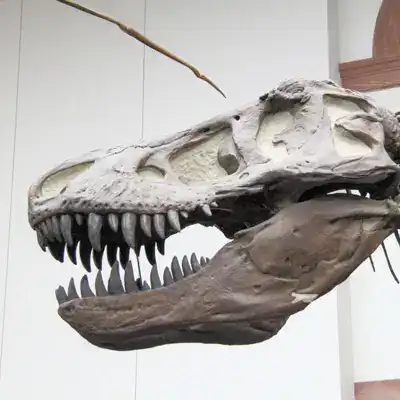
If you are traveling with kids, put this at the top of the list. The Senckenberg holds the largest dinosaur exhibition in Europe, life-size reconstructions greet you outside the building, and inside you can follow a titanosaur's footprints pressed into the floor toward its skeleton. More than 500,000 people come through every year, and the museum ranks second in Germany among natural history collections.
The dinosaur hall reads like a greatest-hits list: a Diplodocus donated by the American Museum of Natural History for the opening of this building in 1907, the duck-billed Parasaurolophus, an Oviraptor, an original Iguanodon, a Tyrannosaurus rex, and the museum's mascot Triceratops. The standout scientifically is a fossilized Psittacosaurus with bristles preserved on its tail and visible fossilized stomach contents.
The smaller exhibits reward a slower pass. The museum holds originals from the Messel Pit, a UNESCO-listed fossil site outside Frankfurt where 50-million-year-old animals were preserved in extraordinary detail, including an ancestor of the modern horse that stood under two feet tall. There is also a cast of Lucy, the near-complete Australopithecus afarensis skeleton, unique in Europe. Upstairs, historic cabinets hold taxidermy including one of about twenty surviving specimens of the quagga, extinct since 1883.
The bird collection is enormous and mostly behind the scenes: 90,000 skins, 5,050 egg sets, 17,000 skeletons and 3,375 specimens preserved in spirits. Since a 2003 renovation the reptile and amphibian section has focused as much on conservation as on biodiversity, and a walk-through rainforest tree lets you climb from forest floor to canopy.
The institution behind the museum is older than the building. Frankfurt citizens founded the Senckenbergische Gesellschaft für Naturforschung on November 22, 1817, on Goethe's initiative, naming it for the physician, naturalist and philanthropist Johann Christian Senckenberg. It still owns and runs the museum along with several research institutes.
One footnote for science travelers. On January 6, 1912, Alfred Wegener stood in this museum and presented his theory of continental drift to the public for the first time. The idea that reshaped the earth sciences was announced in a Frankfurt lecture hall.
More Frankfurt attractions
Landmark
Römer
Frankfurt's city hall since 1405 and the postcard image of the city. Three stepped gables facing the Römerberg square.
Church
Kaiserdom St. Bartholomäus
The Imperial Cathedral, where Holy Roman Emperors were crowned from 1562 to 1792. Its red sandstone tower defines the Old Town skyline.
Observation deck
Main Tower
The one Frankfurt skyscraper with a public observation deck. 656 feet of blue glass in the middle of the banking district.
Landmark
Paulskirche
The birthplace of German democracy. The first freely elected national assembly met in this oval church in 1848.
Museum
Goethe-Haus
The house where Johann Wolfgang von Goethe was born in 1749, rebuilt after the war and furnished with the family's original possessions.
Park
Palmengarten
One of Europe's largest botanical gardens: 54 acres of greenhouses, ponds and themed gardens in the Westend.
Image credits: authors, licenses and sources of all photos are listed on the image credits page.