
Museum · Frankfurt
Museum Angewandte Kunst
The Museum Angewandte Kunst (Museum of Applied Arts) on the Museumsufer holds more than 60,000 objects of European craft from the 12th to the 21st century, plus design, book art, graphics and Islamic and East Asian art. Richard Meier designed the building, which opened in 1985.
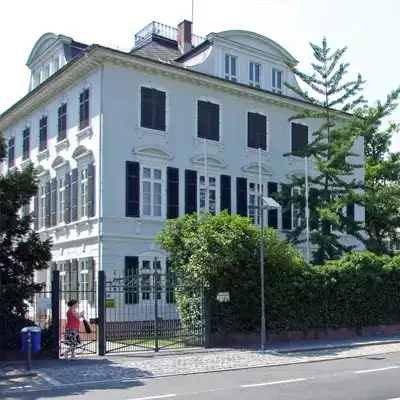
This is the design museum on the Museumsufer, and the building is as much the exhibit as the collection. Richard Meier, the American architect known for the Getty Center in Los Angeles, designed it and opened it in April 1985. The collection runs to more than 60,000 objects: European applied art from the 12th to the 21st century, design, book art and graphics, plus Islamic and East Asian holdings.
The curatorial approach is unusual and worth knowing before you go. Rather than arranging objects chronologically by origin, the museum deliberately mixes them. The core presentation, Elementary Parts, opened in 2014 and places objects from different centuries, regions and disciplines side by side to see what happens. Rotating exhibitions focus on design, fashion and performance, and keep circling the question of what applied art even means now.
Meier came out of the New York Five, the group of architects who in the late 1960s carried forward the European modernism of the 1920s and 1930s, and his signature is white. Here he wrapped an L-shaped complex of three cube-like volumes around an existing neoclassical villa, linking them into a single ensemble with the surrounding park. Inside, a pedestrian ramp connects light-filled exhibition levels, and large windows keep the park and river in view.
A 2013 renovation removed partition walls and additions from the 1990s, restoring Meier's original spatial idea. If you have any interest in architecture, that alone justifies the ticket.
The Villa Metzler at the center of the complex was built in 1804 as a summer house for the apothecary Peter Salzwedel, a square plan with five window bays a side and a pyramidal mansard roof. The banker Georg Friedrich Metzler bought it 50 years later and enlarged it. Since 2009 its nine period rooms have shown domestic interiors from the Baroque through Jugendstil, furnished from the museum's own holdings of furniture, porcelain, carpets and objects.
The park is a small pleasure in its own right. Salzwedel planted ginkgos, red oaks, a tulip tree, a giant sequoia, beeches and chestnuts across roughly 10,000 square meters. Goethe, by then living in Weimar, is said to have known and praised the garden, and his 1815 poem Ginkgo Biloba was written for Marianne von Willemer of Frankfurt with a leaf from this ginkgo.
More Frankfurt attractions
Landmark
Römer
Frankfurt's city hall since 1405 and the postcard image of the city. Three stepped gables facing the Römerberg square.
Church
Kaiserdom St. Bartholomäus
The Imperial Cathedral, where Holy Roman Emperors were crowned from 1562 to 1792. Its red sandstone tower defines the Old Town skyline.
Observation deck
Main Tower
The one Frankfurt skyscraper with a public observation deck. 656 feet of blue glass in the middle of the banking district.
Landmark
Paulskirche
The birthplace of German democracy. The first freely elected national assembly met in this oval church in 1848.
Museum
Goethe-Haus
The house where Johann Wolfgang von Goethe was born in 1749, rebuilt after the war and furnished with the family's original possessions.
Park
Palmengarten
One of Europe's largest botanical gardens: 54 acres of greenhouses, ponds and themed gardens in the Westend.
Image credits: authors, licenses and sources of all photos are listed on the image credits page.