
Museum · Frankfurt
Schirn Kunsthalle
The Schirn Kunsthalle has no permanent collection. It stages large temporary exhibitions of modern and contemporary art, and has shown retrospectives of Kandinsky, Chagall, Frida Kahlo, Giacometti, Bill Viola and Yves Klein.
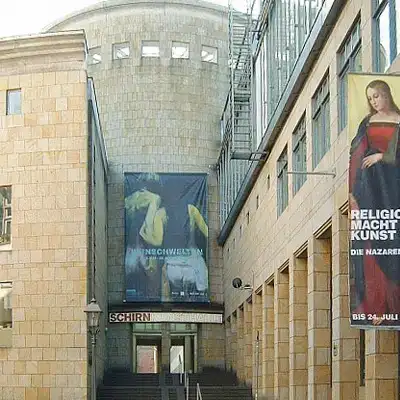
The Schirn is not a collection, it is a program. There is nothing permanent on the walls, so what you see depends entirely on when you come, and the exhibitions are ambitious enough that Frankfurters check the schedule the way New Yorkers check the Whitney. Retrospectives here have covered Wassily Kandinsky, Marc Chagall, Frida Kahlo, Alberto Giacometti, Bill Viola and Yves Klein, and the house co-produces with the Centre Pompidou, Tate, the Guggenheim, the Hermitage and MoMA.
The name is a local joke that stuck. A Schirn was an open-air market stall, the kind that lined Frankfurt's narrow lanes into the 19th century, and the butchers' guild had its stalls in the alleys between this site and the river. The dense Old Town that stood here was destroyed on March 22, 1944, and the ground lay largely untouched until the Kunsthalle was built.
Designed from 1983 by the office of Bangert, Jansen, Scholz and Schultes and opened on February 28, 1986, the building is clad in pale sandstone and assembled from interlocking geometric volumes. The dominant element is a six-story hall roughly 140 meters long and 10 meters wide, about 460 by 33 feet, running east to west. The architect modeled that long gallery on the Uffizi in Florence.
The entrance is unmistakable: a rotunda about 20 meters high, topped with a domed sky, forming a single open room that you pass through to enter. North of it, across the line of the old Bendergasse lane, a semicircular building houses the Schirn Café. A 2012 interior by Kuehn Malvezzi added color-changing lighting to the foyer.
The exhibition floor runs to more than 1,400 square meters, around 15,000 square feet. Since opening, the Schirn has staged over 200 exhibitions, from broad surveys of Viennese Jugendstil, Expressionism, Dada and Surrealism to solo shows for contemporary artists including Thomas Hirschhorn, Jonathan Meese, Yoko Ono and Tobias Rehberger. More than five million people have visited.
It also has a genuine art-crime story. On the night of July 28, 1994, thieves locked themselves inside and overpowered a guard, taking a Turner on loan from Tate and a Caspar David Friedrich on loan from the Hamburger Kunsthalle. Two thieves and a dealer were arrested quickly and later sentenced, but the paintings were eventually recovered by buying them back, and whoever ordered the theft was never brought to court.
More Frankfurt attractions
Landmark
Römer
Frankfurt's city hall since 1405 and the postcard image of the city. Three stepped gables facing the Römerberg square.
Church
Kaiserdom St. Bartholomäus
The Imperial Cathedral, where Holy Roman Emperors were crowned from 1562 to 1792. Its red sandstone tower defines the Old Town skyline.
Observation deck
Main Tower
The one Frankfurt skyscraper with a public observation deck. 656 feet of blue glass in the middle of the banking district.
Landmark
Paulskirche
The birthplace of German democracy. The first freely elected national assembly met in this oval church in 1848.
Museum
Goethe-Haus
The house where Johann Wolfgang von Goethe was born in 1749, rebuilt after the war and furnished with the family's original possessions.
Park
Palmengarten
One of Europe's largest botanical gardens: 54 acres of greenhouses, ponds and themed gardens in the Westend.
Image credits: authors, licenses and sources of all photos are listed on the image credits page.