
Landmark · Frankfurt
Hauptwache and Katharinenkirche
The Hauptwache is the central square of downtown Frankfurt, named for the Baroque guardhouse of 1730 that now holds a cafe. The Katharinenkirche beside it is the largest Protestant church in the city. Eight of nine commuter rail lines and six of nine subway lines serve the station below.
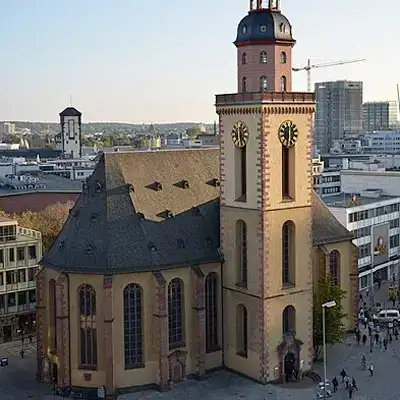
If someone tells you to meet them downtown in Frankfurt, this is where you go. The Hauptwache is the pivot of the inner city: the Zeil shopping street runs east from here, the Freßgass runs west, and below ground sits one of the busiest transit stations in the region, served by eight of the city's nine commuter rail lines and six of its nine subway lines. Getting anywhere in Frankfurt usually means passing through here at least once.
The small Baroque building that gives the square its name was built in 1730 as the headquarters of the city militia, back when Frankfurt was an independent city state, and it included a jail. The square around it was called the parade ground until 1864. In 1833 a small revolutionary group stormed and briefly occupied both this guardhouse and the Konstablerwache in an episode Germans call the Frankfurter Wachensturm. When Prussia annexed the city in 1866 the building lost its military role, kept its jail, became a police station, and from 1904 housed a cafe, which is still its function today.
Burned out in World War II, the guardhouse reopened in provisional form in 1954. When the subway tunnel was driven through downtown in 1967 the whole building had to be dismantled, moved over the new underground station and rebuilt in a slightly shifted position. The commuter rail station opened in 1978, and the square was thoroughly rebuilt again.
The square today centers on a sunken terrace leading down into the underground shopping concourse and station. Frankfurters call it, without affection, das Loch, the hole. Architecturally the square is a mix, since most of the surrounding buildings are postwar, and it is dominated by the church next door.
The Katharinenkirche is the largest Protestant church in Frankfurt, dedicated to the early Christian martyr Catherine of Alexandria. Its site began as a hospice founded in 1343 by Wicker Frosch, a cantor at the cathedral, expanded in 1354 with a convent. After Frankfurt adopted the Reformation in 1533 the convents were dissolved, and the church you see was built between 1678 and 1681 by Melchior Heßler in a restrained Baroque style, 54 meters tall, about 177 feet.
The interior was originally anything but restrained, with 83 paintings of biblical scenes across two levels. The air raid of March 22, 1944, destroyed it. Reconstruction ran from 1950 to October 1954 under Theo Kellner and Wilhelm Massing, keeping the exterior close to the original but simplifying the inside, and further restorations followed between 1978 and 2005, with the tower and roof redone in 2011.
The church has been a center of church music in Frankfurt since it got its first organ in 1625. Georg Philipp Telemann, city music director from 1712 to 1721, made it the focus of his church music work, and the acoustics and organ still draw audiences today.
More Frankfurt attractions
Landmark
Römer
Frankfurt's city hall since 1405 and the postcard image of the city. Three stepped gables facing the Römerberg square.
Church
Kaiserdom St. Bartholomäus
The Imperial Cathedral, where Holy Roman Emperors were crowned from 1562 to 1792. Its red sandstone tower defines the Old Town skyline.
Observation deck
Main Tower
The one Frankfurt skyscraper with a public observation deck. 656 feet of blue glass in the middle of the banking district.
Landmark
Paulskirche
The birthplace of German democracy. The first freely elected national assembly met in this oval church in 1848.
Museum
Goethe-Haus
The house where Johann Wolfgang von Goethe was born in 1749, rebuilt after the war and furnished with the family's original possessions.
Park
Palmengarten
One of Europe's largest botanical gardens: 54 acres of greenhouses, ponds and themed gardens in the Westend.
Image credits: authors, licenses and sources of all photos are listed on the image credits page.