
Zoo · Frankfurt
Frankfurter Zoo
The Frankfurt Zoo holds more than 4,500 animals across roughly 450 species in the eastern part of the inner city. It is the second-oldest zoo in Germany after Berlin and works closely with the Frankfurt Zoological Society on international conservation.
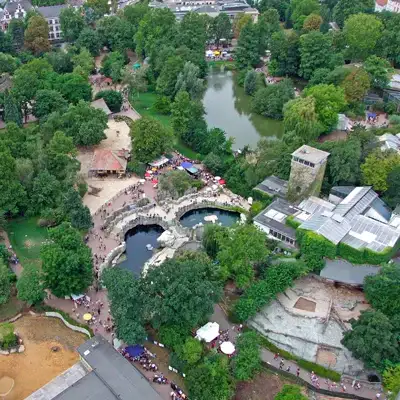
The zoo sits in the eastern inner city, a few subway stops from the Hauptwache, which makes it one of the easiest family stops in Frankfurt. It opened in 1858, second in Germany only to Berlin, and today holds more than 4,500 animals across roughly 450 species.
The layout puts a lot into a compact site. African lions and tigers, seals and otters, and in the Grzimek House a reversed day-night cycle that lets you watch the nocturnal wildlife of Madagascar while it is still light outside. The Exotarium combines aquarium and reptile house, with fish, seahorses, penguins, snakes and crocodiles. In the Borgori-Wald ape house, gorillas, orangutans and other great apes live in a rainforest setting.
There is a playground and several places to eat, so a visit works as a half-day rather than a quick walkthrough. The education department runs guided tours for every age group and organizes birthday parties built around a child's favorite animals, including scavenger hunts through the grounds.
The name that shaped this zoo is Bernhard Grzimek, its director from 1945 to 1974. He rebuilt the wrecked postwar zoo, became one of the most recognizable conservationists in Europe, and made Frankfurt a base for African wildlife protection. His film work brought the Serengeti to a mass audience in Germany the way certain American documentaries did in the United States.
That legacy runs through the Frankfurt Zoological Society, which is closely tied to the zoo and today supports around 40 conservation projects in 19 countries. Its work concentrates on grasslands, wetlands, forests and mountains: the Serengeti, Selous and Mahale ecosystems in Tanzania, Gonarezhou in Zimbabwe, North Luangwa in Zambia, Virunga and Maiko in the Democratic Republic of Congo, the Bukit Tigapuluh rainforest and orangutan reintroduction program in Sumatra, forest protection on the eastern slope of the Andes, and the Altyn Dala steppe initiative for saiga antelope in Kazakhstan.
It is worth knowing this before you buy a ticket. Visiting the Frankfurt zoo funds a conservation organization with genuine international reach, which is not something you can say about every city zoo.
More Frankfurt attractions
Landmark
Römer
Frankfurt's city hall since 1405 and the postcard image of the city. Three stepped gables facing the Römerberg square.
Church
Kaiserdom St. Bartholomäus
The Imperial Cathedral, where Holy Roman Emperors were crowned from 1562 to 1792. Its red sandstone tower defines the Old Town skyline.
Observation deck
Main Tower
The one Frankfurt skyscraper with a public observation deck. 656 feet of blue glass in the middle of the banking district.
Landmark
Paulskirche
The birthplace of German democracy. The first freely elected national assembly met in this oval church in 1848.
Museum
Goethe-Haus
The house where Johann Wolfgang von Goethe was born in 1749, rebuilt after the war and furnished with the family's original possessions.
Park
Palmengarten
One of Europe's largest botanical gardens: 54 acres of greenhouses, ponds and themed gardens in the Westend.
Image credits: authors, licenses and sources of all photos are listed on the image credits page.