
Landmark · Frankfurt
Eiserner Steg
The Eiserner Steg (Iron Footbridge) has spanned the Main between the Old Town and Sachsenhausen since 1869. More than 10,000 people cross it daily, and its railings carry several thousand love locks.
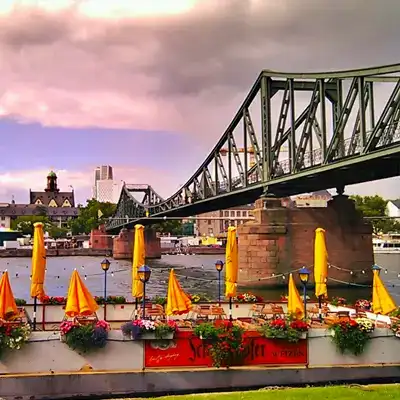
Every visitor to Frankfurt ends up on this bridge, usually twice. It connects the Old Town on the north bank with Sachsenhausen and the museum embankment on the south, it costs nothing, and it delivers the view that ends up on your camera roll: the banking skyline to the north, the row of museums to the south, river traffic underneath.
The bridge exists because Frankfurters got tired of waiting. By the mid-19th century the single bridge over the Main was hopelessly congested, the government kept refusing to build another, so citizens raised the money privately and built this one themselves in 1869. That is a very Frankfurt story, and the same civic pattern shows up in the histories of the Palmengarten, the zoo and the Alte Oper.
It survived both world wars nearly intact until German troops blew it up in the final days of World War II to slow the Allied advance from the south. It was rebuilt in 1946, one of the first bridges in the city to be restored, at a cost of around 220,000 Reichsmark. The steel available right after the war was poor quality, and by the early 1990s corrosion had made the structure unsafe. The city replaced all the steel elements in 1993, added two elevators for step-free access, and raised the clearance to 6.5 meters, about 21 feet, so larger vessels can pass underneath.
Since the 2000s the railings have filled with love locks, the padlock-and-permanent-marker ritual that started on the Pont de l'Archevêché in Paris and spread worldwide. Several thousand hang here now and more appear daily. Vendors around the bridge sell blank and engraved locks, often at tourist prices, so buy yours elsewhere if you plan to take part.
There is a quieter detail most people walk past. Above the northern pier hangs a plaque with a line of Greek, designed by the artist Hagen Bonifer for the Goethe year in 1999. It is a quotation from Homer's Odyssey, roughly: sailing on the wine-dark sea to people of another tongue. For a bridge in a city where more than a third of residents have roots abroad, it is a well-chosen line.
Practical notes: crossing is free, there are stairs at both ends and elevators for wheelchairs and strollers, and subway and streetcar stops sit within a couple of minutes on the Old Town side. Paid parking is available in nearby garages.
More Frankfurt attractions
Landmark
Römer
Frankfurt's city hall since 1405 and the postcard image of the city. Three stepped gables facing the Römerberg square.
Church
Kaiserdom St. Bartholomäus
The Imperial Cathedral, where Holy Roman Emperors were crowned from 1562 to 1792. Its red sandstone tower defines the Old Town skyline.
Observation deck
Main Tower
The one Frankfurt skyscraper with a public observation deck. 656 feet of blue glass in the middle of the banking district.
Landmark
Paulskirche
The birthplace of German democracy. The first freely elected national assembly met in this oval church in 1848.
Museum
Goethe-Haus
The house where Johann Wolfgang von Goethe was born in 1749, rebuilt after the war and furnished with the family's original possessions.
Park
Palmengarten
One of Europe's largest botanical gardens: 54 acres of greenhouses, ponds and themed gardens in the Westend.
Image credits: authors, licenses and sources of all photos are listed on the image credits page.