Landmark · Frankfurt
Frankfurter Wertpapierbörse
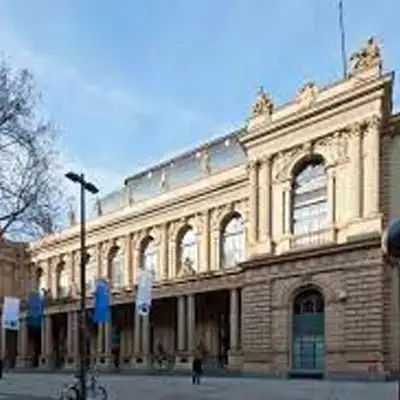
The Frankfurter Wertpapierbörse (Frankfurt Stock Exchange) handles about 90 percent of German securities turnover through its Xetra and Börse Frankfurt venues. The 1879 exchange building and the square in front of it are among the city's most photographed spots.
The bronze bull and bear on the Börsenplatz are the most photographed animals in Frankfurt, and the reason people come here even if they have never bought a share in their lives. Behind them stands the Frankfurt Stock Exchange, tenth largest in the world by market capitalization and the operator of Germany's benchmark indices, the DAX among them. Around 90 percent of German securities turnover runs through its two venues, the electronic Xetra platform and the Börse Frankfurt floor.
The story starts with trade fairs, not stocks. Frankfurt's autumn fair is first documented in 1150, and when Emperor Ludwig the Bavarian added a spring fair in 1330 the city became a major center of commerce and payments. By the early 16th century Frankfurt was rich enough that Martin Luther called it the silver and gold hole of the German empire.
The exchange itself has a specific birth date. There was no single currency in the German lands, payment ran on a bewildering assortment of coins, and floating exchange rates made fraud easy. In 1585 merchants meeting at the fair agreed to fix uniform exchange rates, and that agreement is treated as the founding of the Frankfurt exchange. From then on traders met during each fair to update binding rates, and the name Börse was recorded for these meetings by 1605.
The word itself came from Bruges, in what is now Belgium, where Italian merchants met regularly at the ter buerse square named for the Van der Beurse family who lived there. As the Rothschild bank rose in Frankfurt to become a leading lender to Europe's dynasties, the city grew into an international capital market alongside London and Paris.
The current building opened in 1879, designed by the Frankfurt architects Heinrich Burnitz and Oskar Sommer after the earlier exchange near the Paulskirche became too small. Along with the main train station and the Alte Oper, it is one of the city's most important surviving buildings from the imperial era. It was badly damaged in a 1944 air raid, and trading continued in the cellars.
The exchange reopened in September 1945 under the American military government, one of the first in Germany to do so, and regained its standing after the currency reform of 1948. Electronic trading arrived in 1969. Today almost everything happens on servers, but the building still draws visitors, and the square out front remains the standard backdrop for financial news broadcasts from Germany.
More Frankfurt attractions
Landmark
Römer
Frankfurt's city hall since 1405 and the postcard image of the city. Three stepped gables facing the Römerberg square.
Church
Kaiserdom St. Bartholomäus
The Imperial Cathedral, where Holy Roman Emperors were crowned from 1562 to 1792. Its red sandstone tower defines the Old Town skyline.
Observation deck
Main Tower
The one Frankfurt skyscraper with a public observation deck. 656 feet of blue glass in the middle of the banking district.
Landmark
Paulskirche
The birthplace of German democracy. The first freely elected national assembly met in this oval church in 1848.
Museum
Goethe-Haus
The house where Johann Wolfgang von Goethe was born in 1749, rebuilt after the war and furnished with the family's original possessions.
Park
Palmengarten
One of Europe's largest botanical gardens: 54 acres of greenhouses, ponds and themed gardens in the Westend.
Image credits: authors, licenses and sources of all photos are listed on the image credits page.