
Landmark · Frankfurt
Alte Oper
The Alte Oper (Old Opera House) was inaugurated in 1880, destroyed by bombing in 1944 and reopened in 1981 after citizens raised the money to rebuild it. Its main hall seats around 2,500 and hosts roughly 600 events a year.
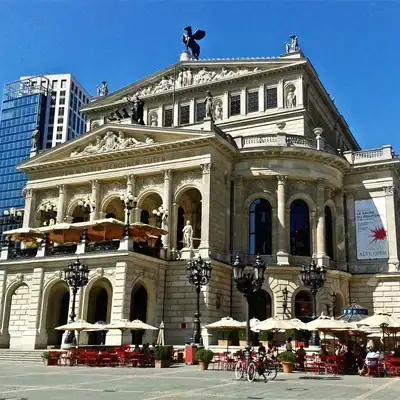
The Alte Oper anchors the western end of downtown, where the Freßgass opens onto the Opernplatz at the edge of the banking district. Designed by the Berlin architect Richard Lucae in the style of the Italian High Renaissance, financed by Frankfurt citizens and built by Philipp Holzmann, it opened on October 20, 1880. Kaiser Wilhelm I attended and reportedly said he could not have allowed himself anything like it in Berlin.
The citizens who paid for it, initially some two million marks, were less enthusiastic. Playing on the inscription across the frieze, dedicated to the true, the beautiful, the good, the Frankfurt dialect poet Adolf Stoltze wrote a couplet that translates roughly as: for the true, the beautiful and the good, the citizenry has to bleed. Frankfurt humor has not changed much.
Allied bombs destroyed the building in 1944, leaving little more than parts of the outer walls. In the 1960s the city administration planned to put an office block on the site, and the Hessian economics minister Rudi Arndt earned the nickname Dynamite Rudi after suggesting that what people called Germany's most beautiful ruin be blown up. He later said he had not meant it seriously.
A citizens initiative pushed for reconstruction from 1953 onward and raised 15 million deutschmarks in donations. The exterior was rebuilt faithfully, the acoustics were rebuilt to modern standards, and the house reopened on August 28, 1981, with Mahler's Eighth Symphony, the Symphony of a Thousand, under Michael Gielen.
It is no longer an opera house. Staged opera moved to the Oper Frankfurt, a modern building completed in 1951, and the Alte Oper today is a concert hall and event venue with roughly 600 events a year. The main hall seats close to 2,500 and is known for excellent acoustics and mahogany paneling; the Mozart-Saal holds about 700 for chamber music, symphonic programs and song recitals. Family concerts, musicals, jazz, rock and pop all appear on the schedule alongside classical programming.
Four independent promoters share the house with its own management: the Frankfurter Bachkonzerte, Hessischer Rundfunk, the Pro Arte concert agency and the Frankfurter Museums-Gesellschaft. The season opens with the Auftakt festival, focused on contemporary music, which regularly sells out months ahead. The Frankfurt Opera Ball is held here each year, and around 40 corporate and institutional events use the smaller halls annually.
Even without a ticket, the building is worth the ten-minute walk from the Hauptwache. On some evenings and for special occasions the facade is lit, and the Opernplatz in front is one of the more pleasant places downtown to sit with a coffee.
More Frankfurt attractions
Landmark
Römer
Frankfurt's city hall since 1405 and the postcard image of the city. Three stepped gables facing the Römerberg square.
Church
Kaiserdom St. Bartholomäus
The Imperial Cathedral, where Holy Roman Emperors were crowned from 1562 to 1792. Its red sandstone tower defines the Old Town skyline.
Observation deck
Main Tower
The one Frankfurt skyscraper with a public observation deck. 656 feet of blue glass in the middle of the banking district.
Landmark
Paulskirche
The birthplace of German democracy. The first freely elected national assembly met in this oval church in 1848.
Museum
Goethe-Haus
The house where Johann Wolfgang von Goethe was born in 1749, rebuilt after the war and furnished with the family's original possessions.
Park
Palmengarten
One of Europe's largest botanical gardens: 54 acres of greenhouses, ponds and themed gardens in the Westend.
Image credits: authors, licenses and sources of all photos are listed on the image credits page.