
Neighborhood guide
Höchst
No Frankfurt district reaches further back than Höchst. Where the Nidda flows into the Main, a defensible plateau above the flood line was settled in the Neolithic, fortified by the Romans and turned into a Frankish village named Hostat in 790.

Höchst sits at the far western edge of Frankfurt, directly on the Main, and holds about 15,600 people on roughly 1.8 square miles. That exposed position on the river once made the town rich and powerful. The Justinuskirche, built in 830, is one of the oldest surviving churches in Germany, and by the year 1000 the settlement, by then called Höchst, belonged to the Electorate of Mainz. The centuries that followed were rough: fire destroyed nearly half the town in 1586, and the Thirty Years' War hit it hard.
The good years came in the 18th and 19th centuries. The Höchst porcelain manufactory was founded in 1746 and its work stands comparison with Meissen, which is more than most German porcelain can claim. A rail connection arrived in 1839. Then, in 1863, came the event that defined the place: the founding of the Farbwerke Höchst dye works, later the Hoechst AG chemicals group. Höchst became a proper town in the Prussian province of Hessen-Nassau in 1885.
The town joined Frankfurt in 1928 but kept a surprising amount of independence, and remained a district seat until 1980. The 1990s were difficult, with a shrinking industrial base and a city development plan from 2006 that has so far delivered less than hoped. None of that touches what brings visitors out here.
What brings visitors is the Altstadt. Höchst has the finest preserved historic town center in Frankfurt, which is not a high bar given what the war did to the rest of the city, but the lanes, the castle, the church and the riverfront genuinely hold up. It is the one outlying district worth a dedicated half day.
Getting there
Höchst lies in the far west of Frankfurt at the mouth of the Nidda, and has had its own rail connection since 1839.
Live from Booking.com
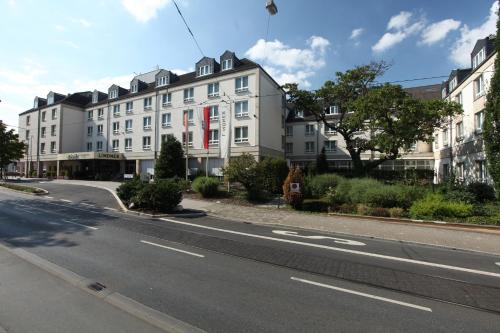
Hotels in and around Höchst
Current rates and availability for properties within about a mile of the center of the quarter.
Prefer Trip.com? Compare Frankfurt hotels on Trip.com →
* Sponsored - booking is handled by Booking.com. As of: October 13, 2026. Prices and availability change daily.
Other Frankfurt neighborhoods
Historic core
Altstadt (the Old Town)
Frankfurt's medieval core around the Römerberg, rebuilt after the war and walkable to nearly every landmark.
Shopping
Innenstadt (downtown)
The Zeil shopping street, the Hauptwache and the skyscraper canyons of the banking district, all in one small central district.
Apple wine
Sachsenhausen (the south-bank quarter)
Across the Main: the Museumsufer museum row, the apple-wine taverns of Alt-Sachsenhausen and the best evening scene in the city.
Arrivals hub
Bahnhofsviertel (the station quarter)
The quarter around the main station: wide boulevards, skyscrapers, street food and a frank reputation. The most convenient landing spot if you arrive by train.
Upscale
Westend
Frankfurt's most expensive address: 19th-century villas, the Palmengarten botanical garden and the tallest towers in the city.
Nightlife
Bornheim
The lively village: Frankfurt's longest shopping street, a dense run of apple-wine taverns and the city's favorite place to live.
Plan the rest of the trip
Ready-made itineraries for one day, three days, a rainy afternoon or a layover at Frankfurt Airport, plus the landmarks worth building them around.