
Neighborhood guide
Altstadt (the Old Town)
The Altstadt is the smallest of Frankfurt's 43 districts and the one every visitor sees first. The Römer city hall, the Imperial Cathedral and St. Paul's Church all stand within a few minutes of one another, and the reconstructed New Old Town fills the gap between them.
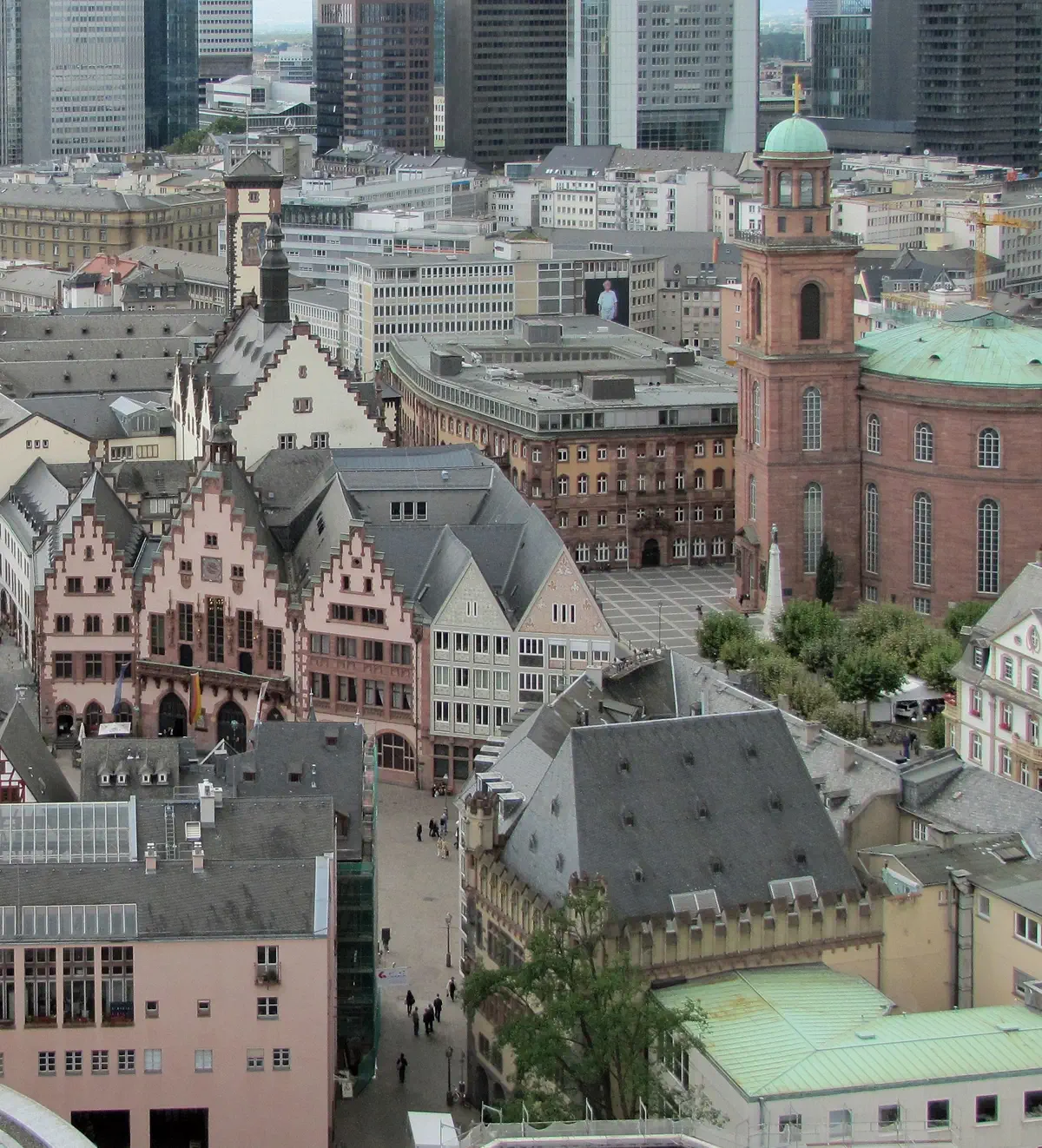
Frankfurt's Old Town sits on the north bank of the Main and covers barely 0.2 square miles, which makes it the city's smallest district with just under 4,000 residents. Almost none of it is original. Allied bombing in World War II erased the medieval center, and what you walk through today is a careful rebuild: 35 houses on roughly 75,000 square feet between the cathedral and the Römer, 15 of them faithful reconstructions of the buildings that stood there before.
The Römerberg is the square everyone photographs. The Römer has served as Frankfurt's city hall since 1405, and its stepped gabled facade is the image that ends up on postcards. Couples come straight out of the registry office inside for wedding photos, flower stalls and street musicians set up in front, and from late November the square fills with the Christmas market. A few steps away, the Archäologischer Garten (Archaeological Garden) exposes Roman foundations and the remains of a Staufer-era wall right in the open air.
The second landmark is the Kaiserdom (Imperial Cathedral of St. Bartholomew). Kings of the Holy Roman Empire were elected here from 1356 and emperors crowned from 1562. Its west tower rises about 312 feet and is visible across the whole city. Close by, the green dome and gold cross of the Paulskirche (St. Paul's Church) mark the building where the first freely elected German national assembly met in 1848. Two more churches anchor the quarter: the Katharinenkirche from 1678 and the Hauptwache guardhouse from 1730.
The Old Town has always been a place of writers and painters. Goethe, Clemens Brentano and the philosopher Arthur Schopenhauer all lived here, as did the composer Georg Philipp Telemann. Today the district holds the Museum für Moderne Kunst (Museum of Modern Art), the Frankfurter Kunstverein, the Schirn Kunsthalle, the Historisches Museum and the Caricatura museum of comic art, plus weekly markets between the Römer and the cathedral where locals still buy flowers, bread and fish.
Where to stay in Altstadt
This is the obvious base for a first visit or a short weekend. You can walk to the cathedral, St. Paul's Church, the Zeil and the Main riverbank without ever using public transit, and the Christmas market happens on your doorstep.
Old Town hotels →Getting there
The Old Town lies on the north bank of the Main, between the cathedral hill and the Römerberg, and connects to Sachsenhausen across the river by the Eiserner Steg (Iron Footbridge).
Live from Booking.com
Hotels in and around Altstadt
Current rates and availability for properties within about a mile of the center of the quarter.
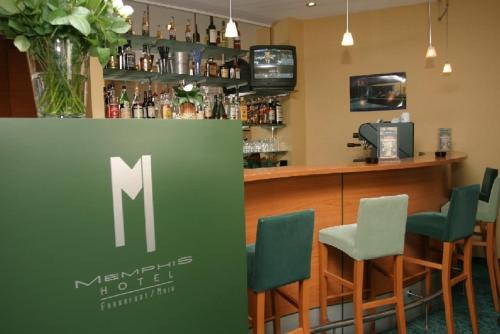
Memphis Hotel
48 € / night

TOWNHOUSE Hotel
58 € / night

Premier Inn Frankfurt City Centre
59 € / night

Hotel Concorde
64 € / night
* Sponsored - booking is handled by Booking.com. As of: September 23, 2026. Prices and availability change daily.
Other Frankfurt neighborhoods
Shopping
Innenstadt (downtown)
The Zeil shopping street, the Hauptwache and the skyscraper canyons of the banking district, all in one small central district.
Apple wine
Sachsenhausen (the south-bank quarter)
Across the Main: the Museumsufer museum row, the apple-wine taverns of Alt-Sachsenhausen and the best evening scene in the city.
Arrivals hub
Bahnhofsviertel (the station quarter)
The quarter around the main station: wide boulevards, skyscrapers, street food and a frank reputation. The most convenient landing spot if you arrive by train.
Upscale
Westend
Frankfurt's most expensive address: 19th-century villas, the Palmengarten botanical garden and the tallest towers in the city.
Nightlife
Bornheim
The lively village: Frankfurt's longest shopping street, a dense run of apple-wine taverns and the city's favorite place to live.
Residential
Nordend
The city's densest and most sought-after residential quarter: Gründerzeit apartment blocks, parks, cafés and no tourists.
Plan the rest of the trip
Ready-made itineraries for one day, three days, a rainy afternoon or a layover at Frankfurt Airport, plus the landmarks worth building them around.