Festival · Late August into early September
Rheingauer Weinmarkt (Rheingau Wine Market)
Ten days at the end of summer, the Rheingau wine region moves into Frankfurt's Fressgass. Around 30 stands, more than 600 wines and sparkling wines, and the people who made them standing behind the counter.
The Rheingau is one of Germany's most famous wine regions, and it starts about 30 minutes west of Frankfurt. Mild winters and warm but never scorching summers make it work. The region runs as a narrow strip from Wicker near Flörsheim on the Main to Lorchhausen on the Rhine, sheltered from winter cold by the Taunus hills, with the river acting as a reflector and heat store for the vines.
Riesling is the point. It covers 84 percent of the planted area, with Pinot Noir at 11 percent, farmed by 280 winemakers across 3,000 hectares (about 7,400 acres). Slate and sandy soils on the higher slopes give firmer, racier wines. The chalky loess in the lower sites gives fuller, more powerful ones. If you have only had off-dry German Riesling from a supermarket shelf, this is where that impression gets corrected.
The tradition is old enough to have a founding legend. The earliest German winegrowing traces back to Roman times, but the Rheingau credits Charlemagne, who is said to have noticed from his palace at Ingelheim that the snow melted first on the Johannisberg and ordered vines planted there. Monastic estates at Eberbach and Johannisberg later did the serious work, and the first cultivated vineyard area is dated to 1135, when Benedictines and then Cistercians cleared the south-facing slopes of the Taunus.
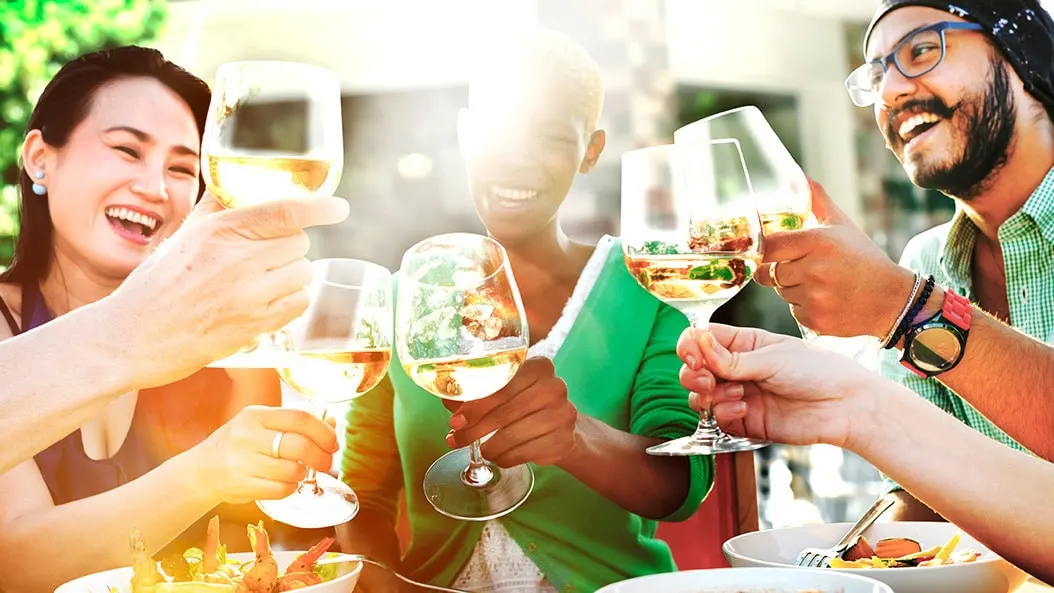
The market has been running since 1978 and now draws an average of more than 400,000 visitors. It takes place in the Fressgass, literally the pig-out alley, Frankfurt's food and shopping promenade downtown, which has stood for good eating in this city for well over a century. Around 30 stands are staffed by the winemakers and their families, and the explicit goal is direct contact: you ask questions, they pour, and if you like something you buy it from the person who made it.
Frankfurt is one of the very few major cities with vineyards of its own. The Lohrberg slope is the easternmost site in the Rheingau, and its wines are poured at the market alongside the rest. The food is regional and unfussy: freshly baked Flammkuchen, the thin Alsatian-style tart, Handkäs mit Musik, a sour milk cheese marinated with onions, a winemaker's platter and Spundekäs, a spiced soft cheese spread from Rheinhessen.
There is deliberately no stage program. The organizers want the focus on the exchange between winemakers and wine drinkers, which makes this one of the easier festivals to enjoy in conversation rather than at volume.
Getting there: the Fressgass sits in the middle of downtown. From Frankfurt Central Station, take the S-Bahn or the U6 or U7 subway to Hauptwache or Alte Oper. There is no parking on the Fressgass itself. The nearest garages are at Goetheplatz, at the Hauptwache on the Kornmarkt, the Börse garage in the Meisengasse and the Palais Quartier garage at Große Eschenheimer Straße 10, all a few minutes' walk away.