Festival · Late November to December
Frankfurt Christmas Market (Weihnachtsmarkt)
Frankfurt's Christmas market, called the Christkindchesmarkt in local dialect, has been documented since 1393. Today around 200 stalls fill the Römerberg, Paulsplatz, the Neue Kräme and the Liebfrauenberg from late November until a few days before Christmas.
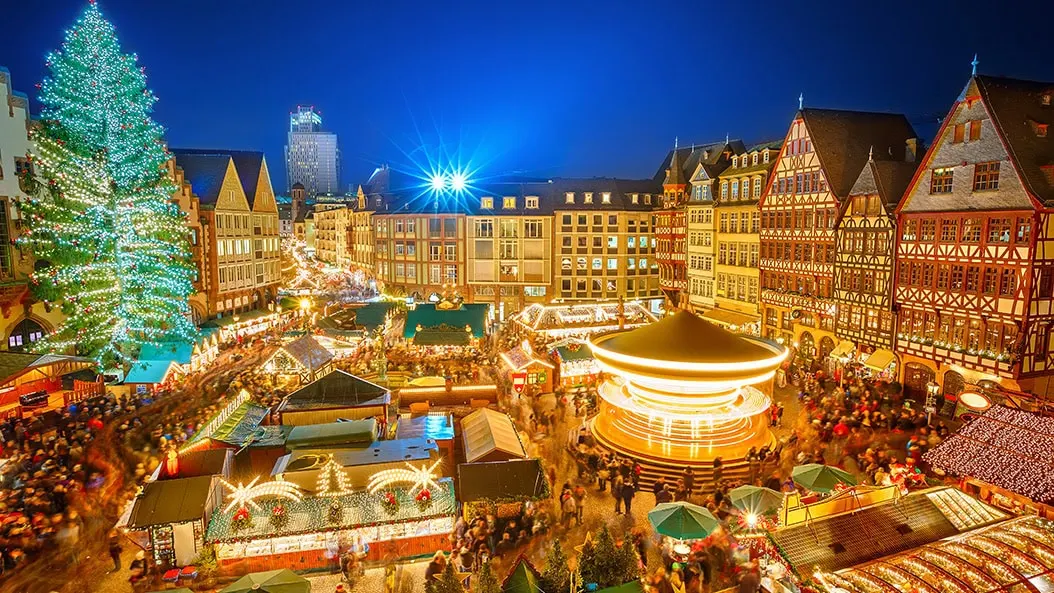
Germans take Christmas markets seriously, and Frankfurt runs one of the biggest. For a few weeks every winter the medieval core of the city turns into a maze of wooden stalls, roasted almond smoke and choir music, and it draws as many international visitors as it does locals. If you have ever heard the phrase German Gemütlichkeit, roughly meaning warm, unhurried coziness, this is where you get to test it in person.
The market is older than most countries. It first shows up in the city records in 1393, though back then it was a supply run rather than a party: people stocked up for a long winter, and only merchants from Frankfurt were allowed to set up a stand. The market as you would recognize it today took shape in the 19th century, when the city started putting up decorated fir trees, residents of Sachsenhausen sold Christmas trees in the halls of the Römer, and traders were restricted to seasonal goods such as toys, ornaments, gingerbread and holiday sweets.
The Römerberg has been the home address since the Middle Ages, with two interruptions. Bombing in World War II destroyed the old setting, and the market wandered from square to square in the unsettled postwar years. It had to move again in the late 1960s and early 1970s while subway construction closed off the Römerberg. By the late 1970s it was back where it belongs, in front of the gabled facades that end up on every postcard.
The modern market is a walking route rather than a single square. It runs from the Zeil, the main shopping street, down across the Liebfrauenberg, the Neue Kräme and Paulsplatz to the Römerberg, and then continues to the Mainkai on the riverbank. Plan on an hour just to walk the whole thing without stopping, longer if you keep getting distracted by the smell of grilled sausage. Stalls sit close together and the crowd moves slowly, so give yourself more time than the map suggests.
Shopping still leans traditional. The most sought-after stands sell wooden folk art from the Erzgebirge, the mountain range near the Czech border that produces Germany's nutcrackers, smoking figurines and carved angels. You will also find traditional and modern tree ornaments, tin toys, hand-decorated candles and marionettes. Frankfurt artists exhibit in the halls of the Römer and in the Paulskirche, so the market doubles as a small art walk.
Eat and drink your way through it. Glühwein, hot spiced red wine, is served in a mug you pay a deposit on, so you can either return the mug for your money back or keep it as a souvenir. Frankfurt takes that idea further: the official market mug is ceramic, changes color and motif every year and is collected like a baseball card. Past designs have shown the Römer, the Alte Oper, the cathedral, the Paulskirche and a portrait of Johann Wolfgang von Goethe, later joined by snowmen, St. Nicholas and Christmas trees set against the skyline. On the food side, look for Quetschemännsche, little figures assembled from dried plums, nuts and raisins, plus Frankfurter Brenten, shaped marzipan cookies, and Bethmännchen, the round marzipan cookie topped with almond halves that the city is known for.
There are set-piece moments worth timing your visit around. The mayor opens the market officially, and the centerpiece is the tree: a red spruce usually more than 30 meters (100 feet) tall, delivered each year from the Hochsauerland region. Many of the trees that have stood on the Römerberg were over a hundred years old. On December 6, St. Nicholas Day, St. Nicholas makes his annual appearance, which is a bigger deal for German children than it is in the United States.
Expect company. In many recent years the market has drawn more than three million visitors, and companies even hold their office Christmas parties among the stalls. Average spending per visitor runs about 15 to 20 euros. Streets across the inner city are closed to cars for the duration and around 150 concrete bollards go up as part of the security plan, which is one more reason to arrive by train or subway rather than trying to park.
One last piece of local trivia. Heinrich Hoffmann, the Frankfurt physician who wrote the children's classic Struwwelpeter, took inspiration from the market for his 1851 Christmas tale König Nussknacker und der arme Reinhold, and the illustrations show the stalls and crowds of the Christkindchesmarkt in his hometown. You can still buy Erzgebirge nutcrackers a few steps from where he watched them.