Festival · Late June into early July
Opernplatzfest (Opera Square Festival)
Every city has a square that works as its living room. In Frankfurt that is the Opernplatz, in front of the Alte Oper, and the Opernplatzfest fills it for ten days with food, wine and live music from 11am to 11pm.
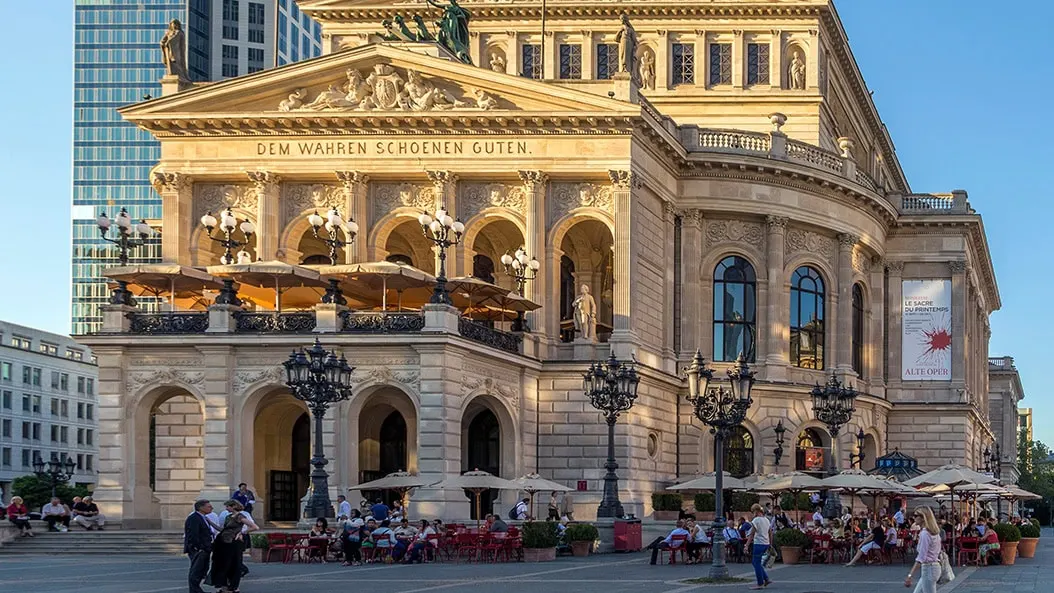
The Opernplatzfest has been held since 1978, and it is the most civilized festival in the Frankfurt calendar: white parasols, tablecloths, a glass of wine, sparkling wine, champagne or apple wine, and a stage that runs from lunchtime piano to evening bands. Doors are open from 11am to 11pm, so you can drop in for an hour on the way through downtown.
The square earned the attention. In the Middle Ages this was part of Frankfurt's city fortifications, and the Bockenheimer Landstraße ran from here out to the village of Bockenheim, which only became part of Frankfurt in 1895. After the walls came down, the city architect Johann Georg Christian Hess built a classical portal to mark the site's importance. It was torn down again in 1875 to make room for a new opera house, finished in 1880 and the largest of its day.
That opera house is now the Alte Oper. Bombed in World War II, it spent years celebrated as the most beautiful ruin in Germany before reopening in 1981 as a concert hall rather than an opera house. The square's other landmark building has been replaced twice: the 1960 Zürich-Haus, at 68 meters (223 feet) Frankfurt's first high-rise, came down in 2002 and the Opernturm went up in 2010. The eye-catcher at ground level is the Lucae fountain. The architect Richard Lucae drew it in 1872, but it took until 1983 for the sculptor Edwin Hüller to build it, 120 tons of granite, inaugurated with a citizens' festival.
The daily rhythm is the appeal. Classical piano concerts run every day from noon to 2pm, which turns an ordinary lunch break into something better, and the evenings belong to live bands. Over the years the lineup has covered jazz, oldies, Latin rhythms, Schlager, rock and travesty shows, with a different act each night.
The food matches the setting: fresh seafood, Spanish tapas, Japanese specialties and modern street food, with the drinks list running from wine and sekt to champagne and, inevitably, apple wine. After dark the whole square turns into a sea of lights with the old opera house floodlit behind it.
The festival exists because of that building. The postwar reconstruction of the Alte Oper meant years of noise, dirt and construction fences for everyone living nearby, and when it finally reopened the city thanked its residents with a party. It was originally called the Lucae-Brunnenfest, after the fountain, but locals shortened it to Opernplatzfest immediately and the name stuck. Take the S1 or S6 from the main station to Taunusanlage and walk a few minutes.