Festival · Mid-June to mid-July
Höchster Schlossfest (Höchst Castle Festival)
Part district festival, part garden party, part concert series: the Höchster Schlossfest has been running since 1957 and fills four weeks from mid-June to mid-July in the Höchst old town.
Höchst sits on the western edge of Frankfurt and has an old town that feels like a separate small city, which for most of its history it was. The Schlossfest has been held here since 1957, when a glass of apple wine cost 27 Pfennig, and it is now one of the most popular events in the Frankfurt calendar. It runs for four weeks, from mid-June to mid-July, centered on the old town and the castle grounds.
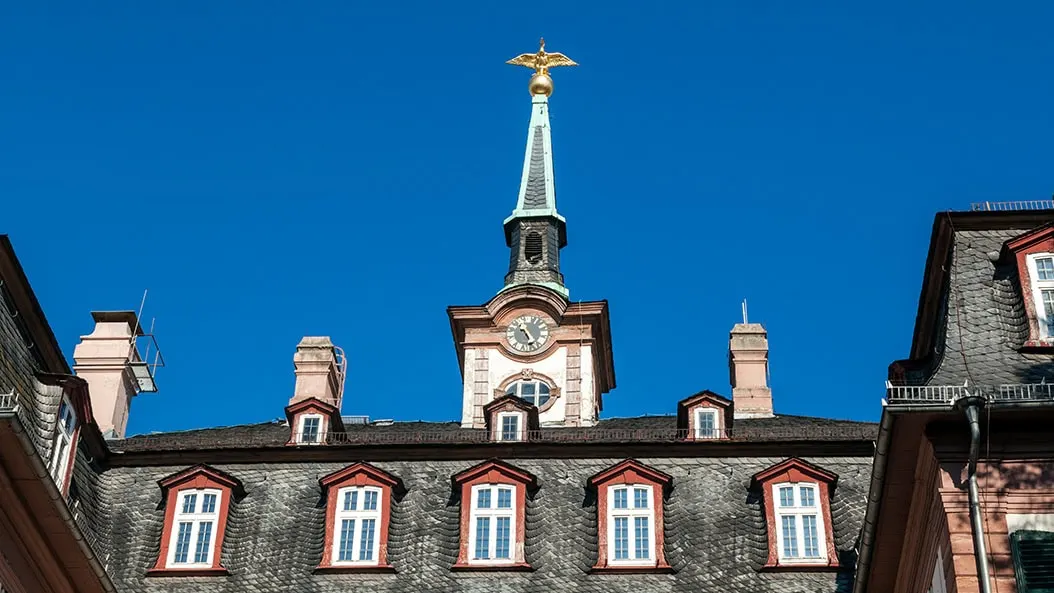
There are two castles. The Altes Schloss, the old castle, was begun in the 14th century and finished in the 16th as the administrative seat of the Archbishopric of Mainz. A 14th-century toll castle stood on the site before it, and only the gothic keep survives from that period. In 1681 the keep was given a baroque cap, which is what makes its silhouette unmistakable. The cap housed the storm bell, rung for fires and severe weather. The building is now a museum covering the long history of Höchst.
The Neues Schloss, the new castle, has no firm founding date but most likely dates from the 16th century and appears in old records as the Cavaliersbau, a guest house. It passed to the Duchy of Nassau in 1803, served the Prussian finance administration from 1866, was bought along with the whole complex by the chemical company Hoechst AG in the early 1960s and used as a guest house, then restored after the German Foundation for Monument Protection took it on. Today it is an upscale event venue and the backdrop for the festival.
The program is genuinely local, put together by public bodies, Höchst residents, the district's many clubs and the church. The Höchster Orgelsommer brings a run of organ concerts to the Justinuskirche. A Kerb, a traditional parish fair, sets up on the bank of the Main. The open-air stage by the castle carries the evenings, with concerts, cabaret and small-format performances. Typical entries have included an evening of songs and poems in Frankfurt dialect, a comedy staged in the parsonage garden of the Justinuskirche, a musical workshop for children where they sing, dance and act, European jazz in the church and a dance evening under the linden trees.
Each year has its own motto and its own emphasis, and the chronicle shows how much the festival has shifted. In 1957 an American military band played and the local gymnastics club performed on the parallel bars, the fire brigade band played for dancing, and the evening ended with a polonaise through the castle garden. By 1967 the Dutch dance theater and the Stuttgart State Opera ballet were performing Romeo and Juliet, alongside Verdi, Mozart and Goethe. In 1977 the festival went in yet another direction, with a dog show, a drawing competition and a jazz band over apple wine.
What holds it together today is the mix: a comfortable old-town street party, an amusement area and a genuine cultural program, all in the same four weeks and all reachable in about 20 minutes from downtown Frankfurt by S-Bahn.